Why Your Chatbot Needs to Reply in Tamil, Not Just English
Discover how auto language-switching in WhatsApp chatbots helps Tamil Nadu businesses reduce drop-offs and build trust with local customers.
By Botify Team
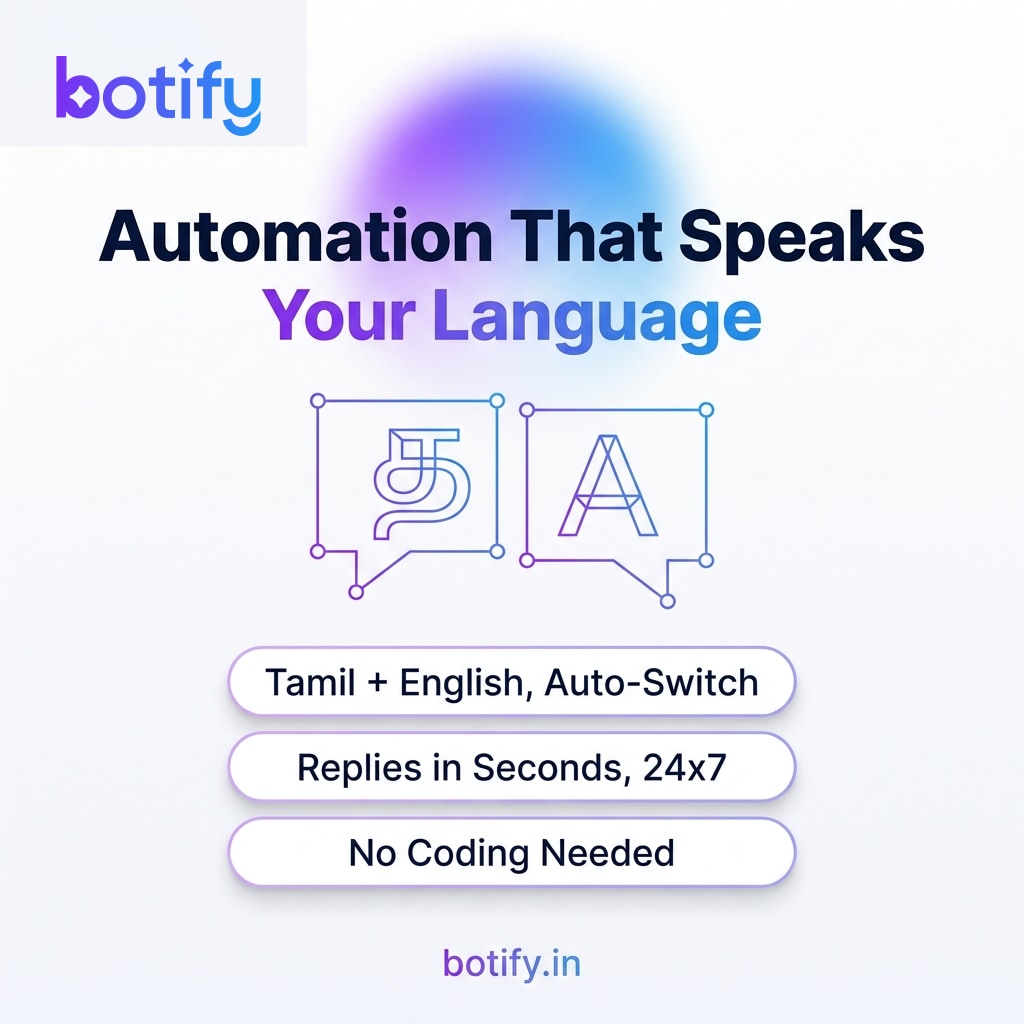
Picture this: a customer in Coimbatore sends you a WhatsApp message asking about your service — in Tamil. Your chatbot, trained entirely in English, fires back a reply that reads like a translated instruction manual. The customer stares at the screen, feels like they have walked into the wrong shop, and closes the chat. You never hear from them again.
This is not a rare edge case. Across Tamil Nadu, a large share of everyday customers are far more comfortable typing in Tamil than in English. If your automation cannot meet them there, you are leaving conversations — and revenue — on the table. The fix is simpler than most business owners expect.
The Language Gap Is a Business Problem, Not a Tech Problem
Many SMB owners treat chatbot language as a cosmetic detail — something to sort out later. In practice, language is the first trust signal a customer receives. Before they evaluate your price, your product, or your location, they decide whether they feel understood. A reply in the wrong language breaks that feeling immediately.
This matters especially in South India, where customers often switch fluidly between Tamil script, Tamil written in English letters (Tanglish), and full English depending on the context. A rigid, single-language bot cannot keep up with how real people actually type.
What Auto Language Detection Actually Does
Modern AI-powered chatbots can read the language or script a customer uses and respond in kind — automatically, within the same message thread. Here is what that looks like in practice:
- A customer types in Tamil script: the bot replies in Tamil.
- A customer types in Tanglish (Tamil words in English letters): the bot picks up the intent and matches the tone.
- A customer switches to English mid-conversation: the bot follows the switch naturally.
- No manual rule-setting is needed for every possible input — the AI infers language from context.
The result is a conversation that feels local and personal, even though it is fully automated and running without any staff involvement.
Where This Makes the Biggest Difference
Language-aware automation has an outsized impact in certain types of businesses. Consider a few common scenarios:
Retail and Kirana Stores
A customer asking about stock availability or delivery timings in Tamil expects a quick, clear answer. A bot that responds in stiff English creates friction at the exact moment you need the sale to move forward.
Clinics and Healthcare Providers
Booking an appointment or asking about a doctor's availability is already a slightly anxious experience for many patients. Receiving a reply in a language they are fully comfortable with lowers that anxiety and increases the chance they complete the booking.
Local Service Businesses
Plumbers, electricians, tutors, travel agents — service providers whose customers are largely local benefit enormously from chatbots that can explain pricing, availability, and next steps in plain Tamil without needing a human agent online at all hours.
How to Set This Up Without Starting from Scratch
You do not need to build separate bots for Tamil and English. The better approach is one unified AI agent that handles both. Here is how to think about the setup:
- Write your core bot responses in both Tamil and English from the start. This is the foundation your AI will draw from.
- Train or configure your bot with common Tanglish phrases your customers actually use — not textbook Tamil.
- Test the bot by sending messages in different language combinations and checking whether the replies feel natural, not translated.
- Set a fallback: if the bot is uncertain about the language, it can ask a simple clarifying question in both Tamil and English on the same message.
- Review conversation logs regularly in the first few weeks and refine responses where the language matching felt off.
Platforms like Botify allow you to build and manage these multilingual AI agents through WhatsApp Business API, so the setup is contained in one place rather than stitched across multiple tools.
A Few Practical Tips Before You Launch
- Use real customer messages to build your training data. Pull from past WhatsApp chats, not from dictionaries.
- Keep Tamil responses conversational, not formal. Customers type the way they speak, not the way they write essays.
- Avoid mixing too many English technical terms into Tamil responses unless your customers already use them naturally.
- Set realistic expectations with your bot: it should excel at your most common 10 to 15 questions before you expand scope.
- Inform customers at the start of a chat that they can message in Tamil or English — a small nudge that reduces hesitation.
Language is not a feature you add later. It is the foundation of every customer relationship you build through automation.
The Competitive Advantage Nobody Is Talking About
Most businesses in Tamil Nadu running WhatsApp automation are doing it entirely in English. That means the moment you deploy a chatbot that genuinely handles Tamil, you stand out — not because you spent more, but because you paid attention to how your customers actually communicate.
Trust compounds quickly when customers feel heard in their own language. They are more likely to complete a purchase, recommend you to others, and return the next time they need something. No discount or promotional offer achieves that as reliably as simply speaking their language from the first message.
If you are already using or evaluating WhatsApp automation for your business, language support is worth prioritising before you optimise anything else. Get that foundation right, and every other part of your customer communication gets easier.
See how Botify works for your businessMore reading
View all articles