Why Click-to-WhatsApp Ads Beat Website Forms for Leads
Learn how Click-to-WhatsApp ads work, why they convert cheaper than landing page forms, and how to set one up for your business today.
By Botify Team
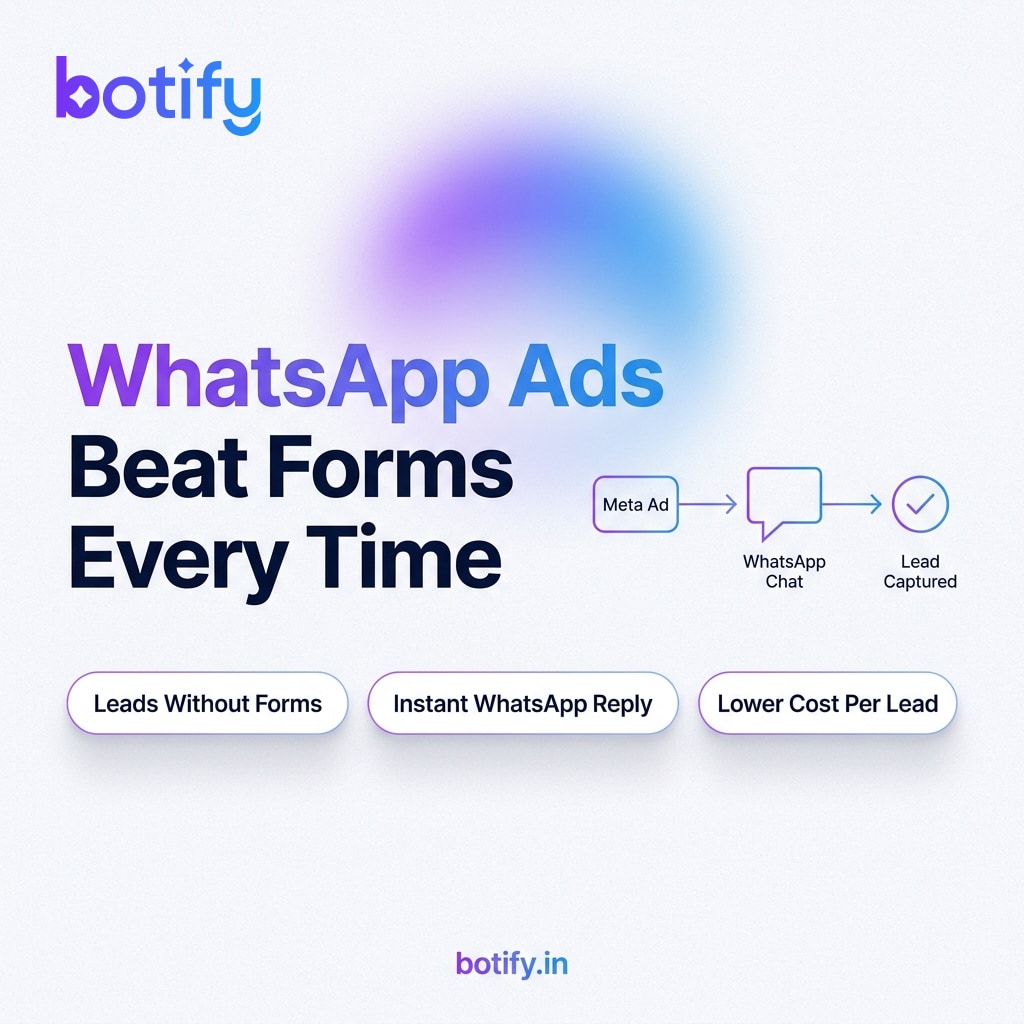
If you are running Meta ads and pointing them at a website form, you are paying for clicks that mostly go nowhere. Someone taps the ad, a page loads slowly on their phone, they fill in their name, wonder whether anyone will actually call them, and then close the tab. That drop-off is not a creative problem — it is a friction problem.
Click-to-WhatsApp ads solve that by removing almost every step between interest and conversation. Here is how they work, why the economics make sense for Indian SMBs, and what you need to have in place before you run your first one.
What Exactly Is a Click-to-WhatsApp Ad?
A Click-to-WhatsApp ad is a standard Meta ad — on Facebook or Instagram — with one difference in the call-to-action button. Instead of Send Traffic to a website or Lead Form, the button is configured to open a WhatsApp chat directly with your business number. The moment a person taps that button, WhatsApp opens on their phone with a pre-filled message ready to send. No new app to install. No form. No landing page.
Meta calls this a Click-to-Message ad type. You create it inside Meta Ads Manager the same way you would create any other campaign. The only additional requirement is that your business has a WhatsApp Business API number connected to the ad account.
The Real Reason They Convert Cheaper
Cost per lead is not just about how much you pay Meta for a click. It is about how many of those clicks turn into actual conversations. Every extra step in your funnel loses people — a slow-loading page, a form with too many fields, a CAPTCHA, a Thank You page that promises someone will get in touch within 48 hours. Each of those moments is an exit.
Click-to-WhatsApp ads collapse the funnel to a single tap. The person is already on their phone, they are already using WhatsApp daily, and the conversation starts in their most familiar app. Because fewer people drop off between the ad click and the first message, you pay for more real conversations out of the same ad budget.
There is another angle worth noting: WhatsApp conversations feel personal. When a business replies quickly and by name, the prospect is already in a dialogue rather than waiting in a queue. That warm handoff tends to produce better close rates downstream, which makes your cost per acquisition lower too — not just your cost per lead.
How the Flow Works End to End
- A user sees your ad on Facebook or Instagram and taps the WhatsApp button.
- WhatsApp opens with a pre-filled message — something like Hi, I saw your ad and want to know more.
- The user sends that message (one tap) and the conversation begins.
- An automated chat flow or AI agent greets them instantly, asks qualifying questions, and captures their requirement.
- If the lead is ready to buy or needs a human, it routes to your team inbox where a sales agent picks up the thread.
- Every message, qualification answer, and contact detail is logged in one place.
The key word in step four is instantly. Response time in the first few seconds dramatically affects whether a lead stays engaged. A chatbot or AI agent handles that gap without putting pressure on your team to be available at every hour. Botify, for example, lets you connect your Click-to-WhatsApp ads directly to automated chat flows and a live team inbox so the handoff from bot to human happens inside the same conversation thread.
What You Need to Set One Up
- A Meta Business account with an active ad account.
- A WhatsApp Business API number — not the regular WhatsApp Business app, but the API version that can be connected to third-party platforms and Meta Ads Manager.
- A welcome message or opening chat flow that greets the lead and asks the first qualifying question.
- A team inbox or AI agent ready to handle incoming chats — ideally within the first minute.
- A clear objective for the conversation: are you booking appointments, qualifying for a callback, sharing a catalogue, or closing directly?
The most common mistake businesses make is setting up the ad but leaving the WhatsApp side empty. If someone taps your ad and gets no reply for two hours, you have paid for a click and created a bad first impression. The automation side is not optional — it is what makes the lower cost per lead actually stick.
Which Businesses See the Most Benefit?
Click-to-WhatsApp ads work particularly well in categories where the buying decision involves a conversation rather than a simple checkout. Think real estate, education, healthcare, financial services, travel, home interiors, and local service businesses. In all of these, a customer wants to ask questions before committing, and WhatsApp is where they are already comfortable asking them.
They also work well for businesses that run seasonal promotions or limited-time offers. Because the conversation starts immediately, you can qualify and follow up with interested buyers while the offer is still fresh — rather than chasing cold form submissions two days later.
The lead that messages you today and gets a reply in 30 seconds is worth far more than the lead who filled a form last Tuesday and is still waiting for a callback.
Three Things to Get Right Before You Go Live
- Write a pre-filled message that signals intent. Instead of a generic Hi, try something like Hi, I am interested in your offer for [product]. This tells your automation what the person wants before the first exchange.
- Keep your opening bot message short and focused. Ask one qualifying question — budget, location, timeline, or use case. Do not bombard the lead with a wall of text the moment they say hello.
- Set up a fallback route. If your AI agent cannot answer a question, or if the lead explicitly asks for a human, the conversation should route to a live agent immediately. A frustrated lead left talking to a bot that keeps looping is worse than no automation at all.
Click-to-WhatsApp ads are one of the most practical tools available to Indian SMBs running paid social today. The setup is not complicated, the cost advantage is real, and the conversation format matches how most customers in this market already prefer to communicate. If you are spending money on Meta ads and sending people to a form, this is worth testing in your next campaign cycle.
See how Botify works for your businessMore reading
View all articles